
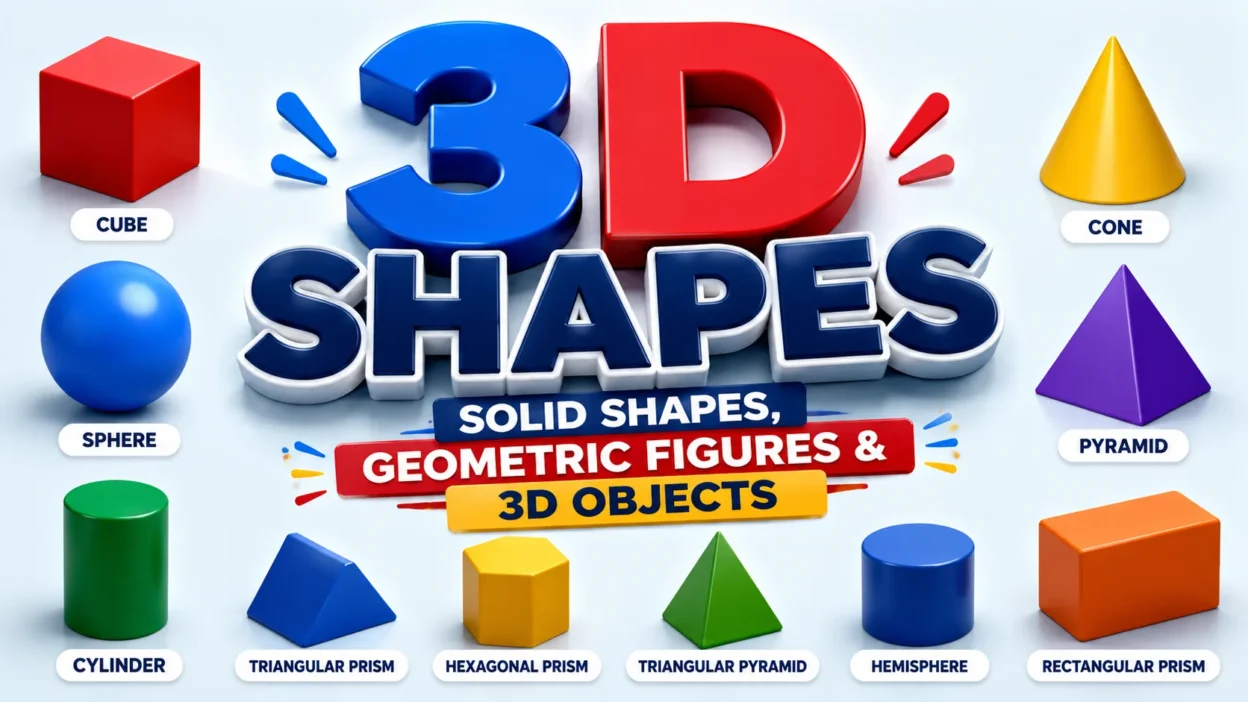
Looking for 3D shapes names for a school project, math lesson, classroom activity, worksheet, homework, or simply to learn more about solid geometry? Three-dimensional shapes are objects that have length, width, and height, which means they take up space. Unlike flat, two-dimensional shapes such as circles, squares, and triangles, 3D shapes have depth and can be viewed from different angles.
Some three-dimensional shapes are familiar from everyday life. A cube resembles a dice, a sphere looks like a ball, and a cylinder resembles a can. Other solids, such as dodecahedrons, icosahedrons, triangular prisms, pentagonal pyramids, and truncated cones, are more commonly studied in geometry.
Learning the names of solid shapes makes it easier to understand their faces, edges, vertices, bases, curved surfaces, nets, volume, and surface area. It also helps students recognize how geometry appears in architecture, engineering, science, art, packaging, and objects around us.
This guide includes 240+ 3D shape names and related geometric terms, organized into useful categories. You’ll find common solid shapes, prisms, pyramids, polyhedra, curved solids, regular solids, unusual geometric figures, and real-world examples.
Common 3D Shapes Names
These are some of the most familiar solid shapes taught in elementary and middle-school geometry.
- Cube
- Cuboid
- Rectangular prism
- Sphere
- Cylinder
- Cone
- Triangular prism
- Square prism
- Pentagonal prism
- Hexagonal prism
- Triangular pyramid
- Square pyramid
- Pentagonal pyramid
- Hexagonal pyramid
- Octagonal pyramid
- Tetrahedron
- Octahedron
- Dodecahedron
- Icosahedron
- Hemisphere
- Ellipsoid
- Torus
- Prism
- Pyramid
- Polyhedron
- Trapezoidal prism
- Parallelepiped
- Rhombohedron
- Frustum
- Cone frustum
- Pyramid frustum
- Triangular bipyramid
- Square bipyramid
- Pentagonal bipyramid
- Hexagonal bipyramid
- Truncated prism
- Truncated pyramid
- Truncated cone
- Oblique prism
- Oblique pyramid
- Right prism
- Right pyramid
- Regular prism
- Regular pyramid
- Irregular prism
- Irregular pyramid
3D Geometric Shapes
Three-dimensional geometry includes many families of solids. These names are useful when studying geometry beyond the most basic shapes.
- Cube
- Cuboid
- Sphere
- Cylinder
- Cone
- Prism
- Pyramid
- Tetrahedron
- Octahedron
- Dodecahedron
- Icosahedron
- Triangular prism
- Pentagonal prism
- Hexagonal prism
- Octagonal prism
- Triangular pyramid
- Square pyramid
- Pentagonal pyramid
- Hexagonal pyramid
- Heptagonal pyramid
- Octagonal pyramid
- Nonagonal pyramid
- Decagonal pyramid
- Parallelepiped
- Rhombohedron
- Trapezoidal prism
- Frustum
- Torus
- Ellipsoid
- Hemisphere
- Spheroid
- Oblate spheroid
- Prolate spheroid
- Hyperboloid
- Paraboloid
- Cone
- Elliptic cone
- Circular cone
- Wedge
- Prismatoid
- Antiprism
- Bipyramid
- Cupola
- Rotunda
- Polyhedron
- Geodesic sphere
- Goldberg polyhedron
- Archimedean solid
- Platonic solid
3D Shapes for Kids 🧒
Young learners usually begin with a small group of recognizable solid shapes. These names are easy to connect with objects children see every day.
- Cube
- Sphere
- Cone
- Cylinder
- Cuboid
- Rectangular prism
- Pyramid
- Triangular prism
- Hemisphere
- Prism
- Ball
- Dice
- Box
- Can
- Ice-cream cone
- Globe
- Egg
- Toy block
- Brick
- Tube
- Drum
- Party hat
- Funnel
- Marble
- Orange
- Lemon
- Building block
- Cereal box
- Shoe box
- Tissue box
- Pencil
- Battery
- Candle
- Bucket
- Bowl
- Plate
- Ring
- Donut
- Toy pyramid
- Tent
- Toblerone prism
- Rubik’s Cube
- Soccer ball
- Baseball
- Basketball
- Football
- Globe sphere
- Traffic cone
- Water bottle
- Soda can
3D Shapes in Geometry
Geometry uses specific terms to describe solid figures according to their surfaces, edges, vertices, and dimensions.
- Solid
- Solid figure
- Three-dimensional figure
- Polyhedron
- Regular polyhedron
- Irregular polyhedron
- Convex polyhedron
- Concave polyhedron
- Prism
- Pyramid
- Curved solid
- Platonic solid
- Archimedean solid
- Johnson solid
- Catalan solid
- Kepler–Poinsot solid
- Geometric solid
- Composite solid
- Simple solid
- Complex solid
- Uniform polyhedron
- Quasiregular polyhedron
- Semiregular polyhedron
- Isogonal solid
- Isotoxal solid
- Isogonal polyhedron
- Faceted solid
- Truncated solid
- Stellated solid
- Dual polyhedron
- Vertex
- Edge
- Face
- Base
- Surface
- Curved surface
- Flat face
- Lateral face
- Height
- Slant height
- Radius
- Diameter
- Axis
- Center
- Net
- Cross-section
- Volume
- Surface area
- Solid geometry
- Spatial geometry
3D Shapes With Flat Faces
Polyhedra are three-dimensional objects made from flat polygonal faces. Their faces meet along edges and their edges meet at vertices.
- Cube
- Cuboid
- Rectangular prism
- Triangular prism
- Pentagonal prism
- Hexagonal prism
- Heptagonal prism
- Octagonal prism
- Nonagonal prism
- Decagonal prism
- Triangular pyramid
- Square pyramid
- Pentagonal pyramid
- Hexagonal pyramid
- Heptagonal pyramid
- Octagonal pyramid
- Nonagonal pyramid
- Decagonal pyramid
- Tetrahedron
- Octahedron
- Dodecahedron
- Icosahedron
- Rhombohedron
- Parallelepiped
- Trapezoidal prism
- Triangular bipyramid
- Square bipyramid
- Pentagonal bipyramid
- Hexagonal bipyramid
- Antiprism
- Triangular antiprism
- Square antiprism
- Pentagonal antiprism
- Hexagonal antiprism
- Truncated tetrahedron
- Truncated cube
- Truncated octahedron
- Truncated dodecahedron
- Truncated icosahedron
- Cuboctahedron
- Icosidodecahedron
- Rhombicuboctahedron
- Rhombicosidodecahedron
- Snub cube
- Snub dodecahedron
- Great rhombicuboctahedron
- Great rhombicosidodecahedron
- Small rhombicuboctahedron
- Small rhombicosidodecahedron
3D Shapes With Curved Surfaces
Some solids contain curved surfaces instead of being made entirely from flat polygonal faces.
- Sphere
- Hemisphere
- Cylinder
- Cone
- Torus
- Ellipsoid
- Spheroid
- Oblate spheroid
- Prolate spheroid
- Circular cylinder
- Elliptic cylinder
- Circular cone
- Elliptic cone
- Paraboloid
- Hyperboloid
- Elliptic paraboloid
- Hyperbolic paraboloid
- One-sheet hyperboloid
- Two-sheet hyperboloid
- Spherical cap
- Spherical segment
- Spherical sector
- Spherical shell
- Cylindrical shell
- Conical shell
- Frustum
- Conical frustum
- Cylindrical frustum
- Elliptic cylinder
- Rounded cylinder
- Capsule
- Spherocylinder
- Ovoid
- Egg shape
- Lens
- Spindle
- Lemon shape
- Ring torus
- Horn torus
- Self-intersecting torus
- Elliptic torus
- Circular torus
- Parabolic cylinder
- Hyperbolic cylinder
- Circular paraboloid
- Elliptic paraboloid
- Hyperboloid of revolution
- Cone surface
- Cylinder surface
- Sphere surface
Types of Prisms
A prism has two parallel, congruent bases connected by rectangular or parallelogram-shaped lateral faces.
- Triangular prism
- Square prism
- Rectangular prism
- Pentagonal prism
- Hexagonal prism
- Heptagonal prism
- Octagonal prism
- Nonagonal prism
- Decagonal prism
- Hendecagonal prism
- Dodecagonal prism
- Tridecagonal prism
- Tetradecagonal prism
- Pentadecagonal prism
- Hexadecagonal prism
- Heptadecagonal prism
- Octadecagonal prism
- Enneadecagonal prism
- Icosagonal prism
- Regular triangular prism
- Regular pentagonal prism
- Regular hexagonal prism
- Regular octagonal prism
- Right triangular prism
- Right rectangular prism
- Right pentagonal prism
- Right hexagonal prism
- Oblique triangular prism
- Oblique rectangular prism
- Oblique pentagonal prism
- Oblique hexagonal prism
- Trapezoidal prism
- Rhombic prism
- Parallelogram prism
- Kite prism
- Isosceles triangular prism
- Scalene triangular prism
- Equilateral triangular prism
- Regular prism
- Irregular prism
- Uniform prism
- Prismatoid
- Crossed prism
- Twisted prism
- Truncated prism
- Compound prism
- Star prism
- Decagonal prism
- Dodecagonal prism
- Polygonal prism
- Circular prism
- Curved prism
- General prism
Types of Pyramids
A pyramid has a polygonal base and triangular faces that meet at a common point called the apex.
- Triangular pyramid
- Square pyramid
- Pentagonal pyramid
- Hexagonal pyramid
- Heptagonal pyramid
- Octagonal pyramid
- Nonagonal pyramid
- Decagonal pyramid
- Hendecagonal pyramid
- Dodecagonal pyramid
- Tridecagonal pyramid
- Tetradecagonal pyramid
- Pentadecagonal pyramid
- Hexadecagonal pyramid
- Heptadecagonal pyramid
- Octadecagonal pyramid
- Enneadecagonal pyramid
- Icosagonal pyramid
- Regular pyramid
- Irregular pyramid
- Right pyramid
- Oblique pyramid
- Square-based pyramid
- Triangular-based pyramid
- Pentagonal-based pyramid
- Hexagonal-based pyramid
- Octagonal-based pyramid
- Star pyramid
- Truncated pyramid
- Frustum pyramid
- Regular tetrahedron
- Square tetrahedron
- Pentagonal pyramid
- Hexagonal pyramid
- Heptagonal pyramid
- Octagonal pyramid
- Nonagonal pyramid
- Decagonal pyramid
- Polygonal pyramid
- Composite pyramid
- Compound pyramid
- Elongated pyramid
- Gyroelongated pyramid
- Bipyramid
- Triangular bipyramid
- Square bipyramid
- Pentagonal bipyramid
- Hexagonal bipyramid
- Polygonal bipyramid
Polyhedra Names
Polyhedra are solid shapes whose surfaces consist of flat polygonal regions.
- Tetrahedron
- Cube
- Octahedron
- Dodecahedron
- Icosahedron
- Truncated tetrahedron
- Truncated cube
- Truncated octahedron
- Truncated dodecahedron
- Truncated icosahedron
- Cuboctahedron
- Icosidodecahedron
- Rhombicuboctahedron
- Rhombicosidodecahedron
- Snub cube
- Snub dodecahedron
- Triangular prism
- Pentagonal prism
- Hexagonal prism
- Octagonal prism
- Triangular antiprism
- Square antiprism
- Pentagonal antiprism
- Hexagonal antiprism
- Gyroelongated square pyramid
- Elongated triangular pyramid
- Elongated square pyramid
- Elongated pentagonal pyramid
- Elongated hexagonal pyramid
- Gyroelongated triangular pyramid
- Gyroelongated pentagonal pyramid
- Gyroelongated hexagonal pyramid
- Triangular cupola
- Square cupola
- Pentagonal cupola
- Hexagonal cupola
- Triangular rotunda
- Pentagonal rotunda
- Rhombic dodecahedron
- Rhombic triacontahedron
- Deltoidal icositetrahedron
- Deltoidal hexecontahedron
- Disdyakis dodecahedron
- Disdyakis triacontahedron
- Triakis tetrahedron
- Triakis octahedron
- Tetrakis hexahedron
- Pentagonal trapezohedron
- Hexagonal trapezohedron
Platonic Solid Names
There are five regular convex polyhedra known as the Platonic solids. Each has congruent regular polygon faces and the same number of faces meeting at every vertex.
- Tetrahedron
- Cube
- Octahedron
- Dodecahedron
- Icosahedron
The five Platonic solids are especially important in solid geometry because they demonstrate some of the most symmetrical forms possible using regular polygons.
Tetrahedron
A tetrahedron has four triangular faces, six edges, and four vertices.
Cube
A cube has six square faces, twelve edges, and eight vertices.
Octahedron
An octahedron has eight triangular faces, twelve edges, and six vertices.
Dodecahedron
A dodecahedron has twelve pentagonal faces, thirty edges, and twenty vertices.
Icosahedron
An icosahedron has twenty triangular faces, thirty edges, and twelve vertices.
Archimedean Solid Names
Archimedean solids are highly symmetrical convex polyhedra made from regular polygon faces, with the same arrangement of faces around every vertex.
- Truncated tetrahedron
- Cuboctahedron
- Truncated cube
- Truncated octahedron
- Rhombicuboctahedron
- Truncated cuboctahedron
- Snub cube
- Icosidodecahedron
- Truncated dodecahedron
- Truncated icosahedron
- Rhombicosidodecahedron
- Truncated icosidodecahedron
- Snub dodecahedron
These solids are often used to demonstrate symmetry, geometric transformations, tessellation concepts, and relationships between different regular polyhedra.
Unusual 3D Shape Names
Beyond basic prisms and pyramids, geometry contains many fascinating solids with unusual structures.
- Gyrobifastigium
- Square gyrobicupola
- Triangular cupola
- Square cupola
- Pentagonal cupola
- Hexagonal cupola
- Triangular rotunda
- Pentagonal rotunda
- Elongated square gyrobicupola
- Elongated triangular cupola
- Elongated square cupola
- Elongated pentagonal cupola
- Gyroelongated square cupola
- Gyroelongated pentagonal cupola
- Augmented triangular prism
- Augmented pentagonal prism
- Augmented hexagonal prism
- Augmented dodecahedron
- Parabidiminished rhombicosidodecahedron
- Gyrate rhombicosidodecahedron
- Diminished rhombicosidodecahedron
- Triaugmented triangular prism
- Biaugmented triangular prism
- Triaugmented dodecahedron
- Metabidiminished icosahedron
- Parabiaugmented dodecahedron
- Triangular orthobicupola
- Square orthobicupola
- Pentagonal orthobicupola
- Hexagonal orthobicupola
- Triangular gyroprism
- Square gyroprism
- Pentagonal gyroprism
- Hexagonal gyroprism
- Rhombic dodecahedron
- Rhombic triacontahedron
- Deltoidal hexecontahedron
- Pentagonal hexecontahedron
- Disdyakis dodecahedron
- Disdyakis triacontahedron
- Trapezoidal icositetrahedron
- Trapezoidal hexecontahedron
- Pentagonal icositetrahedron
- Pentagonal hexecontahedron
- Hexagonal trapezohedron
- Pentagonal trapezohedron
- Deltoidal icositetrahedron
- Triakis octahedron
- Tetrakis hexahedron
3D Shapes and Real-Life Objects 🌎
Many solid shapes appear naturally in objects around us. Connecting mathematical solids to familiar objects makes geometry easier to understand.
- Dice — cube
- Soccer ball — sphere
- Globe — sphere
- Orange — sphere
- Can — cylinder
- Soda can — cylinder
- Candle — cylinder
- Battery — cylinder
- Ice-cream cone — cone
- Party hat — cone
- Traffic cone — cone
- Funnel — cone
- Shoe box — cuboid
- Cereal box — cuboid
- Brick — cuboid
- Book — cuboid
- Tissue box — cuboid
- Gift box — cube
- Rubik’s Cube — cube
- Pyramid monument — pyramid
- Tent — triangular prism
- Toblerone box — triangular prism
- Roof section — triangular prism
- Water bottle — cylinder
- Drum — cylinder
- Pipe — cylinder
- Ring — torus
- Donut — torus
- Egg — ellipsoid
- Rugby ball — prolate spheroid
- Football — prolate spheroid
- Capsule — spherocylinder
- Bowl — hemisphere
- Dome — hemisphere
- Iceberg — irregular solid
- Crystal — polyhedron
- Dice — polyhedron
- Toy block — cube
- Building — cuboid
- Storage box — cuboid
- Pyramid roof — pyramid
- Funnel — cone
- Lamp shade — frustum
- Flower pot — frustum
- Bucket — frustum
- Lampshade — truncated cone
- Paper cup — truncated cone
- Pencil — hexagonal prism
- Eraser — cuboid
- Marble — sphere
- Pearl — sphere
3D Shape Names for School Projects
If you are making a classroom chart, geometry poster, worksheet, or science project, these names provide a useful collection of common and advanced solids.
- Cube
- Cuboid
- Sphere
- Cone
- Cylinder
- Triangular prism
- Rectangular prism
- Pentagonal prism
- Hexagonal prism
- Octagonal prism
- Triangular pyramid
- Square pyramid
- Pentagonal pyramid
- Hexagonal pyramid
- Tetrahedron
- Octahedron
- Dodecahedron
- Icosahedron
- Hemisphere
- Torus
- Ellipsoid
- Frustum
- Prism
- Pyramid
- Polyhedron
- Parallelepiped
- Rhombohedron
- Bipyramid
- Antiprism
- Truncated pyramid
- Truncated cone
- Truncated prism
- Wedge
- Spheroid
- Paraboloid
- Hyperboloid
- Cupola
- Rotunda
- Platonic solid
- Archimedean solid
- Catalan solid
- Johnson solid
- Geodesic sphere
- Composite solid
- Irregular solid
- Regular solid
- Convex solid
- Concave solid
- Solid figure
3D Shapes With Vertices
A vertex is a point where edges meet. Different solids have different numbers of vertices.
- Tetrahedron
- Cube
- Cuboid
- Triangular prism
- Pentagonal prism
- Hexagonal prism
- Octagonal prism
- Triangular pyramid
- Square pyramid
- Pentagonal pyramid
- Hexagonal pyramid
- Octagonal pyramid
- Dodecahedron
- Icosahedron
- Octahedron
- Rhombohedron
- Parallelepiped
- Trapezoidal prism
- Bipyramid
- Antiprism
- Truncated cube
- Truncated tetrahedron
- Truncated octahedron
- Cuboctahedron
- Icosidodecahedron
- Rhombicuboctahedron
- Rhombicosidodecahedron
- Snub cube
- Snub dodecahedron
- Geodesic polyhedron
- Cupola
- Rotunda
- Prismatoid
- Wedge
- Pyramid frustum
- Truncated pyramid
- Augmented prism
- Elongated pyramid
- Gyroelongated pyramid
- Composite polyhedron
- Regular polyhedron
- Irregular polyhedron
- Convex polyhedron
- Concave polyhedron
- Uniform polyhedron
- Quasiregular polyhedron
- Semiregular polyhedron
- Star polyhedron
- Compound polyhedron
- Faceted solid
3D Shapes With Edges
Edges are line segments where two faces meet. Flat-faced solids usually have clearly defined edges, while curved solids such as spheres do not.
- Cube
- Cuboid
- Rectangular prism
- Triangular prism
- Pentagonal prism
- Hexagonal prism
- Octagonal prism
- Triangular pyramid
- Square pyramid
- Pentagonal pyramid
- Hexagonal pyramid
- Octagonal pyramid
- Tetrahedron
- Octahedron
- Dodecahedron
- Icosahedron
- Rhombohedron
- Parallelepiped
- Trapezoidal prism
- Bipyramid
- Antiprism
- Truncated tetrahedron
- Truncated cube
- Truncated octahedron
- Truncated dodecahedron
- Truncated icosahedron
- Cuboctahedron
- Icosidodecahedron
- Rhombicuboctahedron
- Rhombicosidodecahedron
- Snub cube
- Snub dodecahedron
- Cupola
- Rotunda
- Prismatoid
- Wedge
- Frustum
- Truncated pyramid
- Augmented prism
- Elongated pyramid
- Gyroelongated pyramid
- Regular polyhedron
- Irregular polyhedron
- Convex polyhedron
- Concave polyhedron
- Uniform polyhedron
- Compound polyhedron
- Star polyhedron
- Faceted solid
3D Shapes and Their Properties
Understanding the properties of a solid shape is just as important as learning its name. Students commonly compare shapes by their faces, edges, vertices, bases, and curved surfaces.
Cube
A cube has six square faces, twelve equal edges, and eight vertices. Every face is the same size and shape.
Cuboid
A cuboid, also called a rectangular prism, has six rectangular faces. Opposite faces are equal, and it has twelve edges and eight vertices.
Sphere
A sphere is a perfectly round solid in which every point on the surface is the same distance from the center. It has one continuous curved surface and no edges or vertices.
Cylinder
A cylinder has two parallel circular bases joined by a curved surface. A typical right circular cylinder has two circular edges.
Cone
A cone has one circular base and one curved surface that narrows to a single vertex called the apex.
Triangular Prism
A triangular prism has two congruent triangular bases and three rectangular lateral faces. It has five faces, nine edges, and six vertices.
Pyramid
A pyramid has one polygonal base and triangular side faces that meet at an apex.
3D Shapes vs. 2D Shapes
The main difference between two-dimensional and three-dimensional shapes is depth.
A 2D shape is flat and has length and width. Examples include:
- Circle
- Square
- Rectangle
- Triangle
- Pentagon
- Hexagon
- Octagon
- Oval
- Rhombus
- Trapezoid
A 3D shape has length, width, and height. Examples include:
- Cube
- Sphere
- Cylinder
- Cone
- Cuboid
- Prism
- Pyramid
- Tetrahedron
- Dodecahedron
- Icosahedron
A useful way to remember the difference is that 2D shapes can be drawn on a flat surface, while 3D shapes represent objects that occupy space.
How to Identify a 3D Shape
When identifying a solid shape, look at several properties instead of relying only on its appearance.
First, check whether the object has flat faces or curved surfaces. A cube has only flat faces, while a sphere has a curved surface.
Next, count the faces, edges, and vertices when possible. These properties can quickly distinguish one polyhedron from another.
Look at the shape of the base as well. A triangular base may indicate a triangular prism or triangular pyramid, while a circular base can indicate a cylinder or cone.
Finally, check whether the sides remain parallel or meet at an apex. A prism has parallel congruent bases, while a pyramid has triangular faces that converge toward one point.
Frequently Asked Questions
What are the basic 3D shapes?
The most common basic 3D shapes are cube, cuboid, sphere, cylinder, cone, prism, pyramid, and hemisphere.
What are the 5 main 3D shapes?
The five Platonic solids are tetrahedron, cube, octahedron, dodecahedron, and icosahedron. For elementary learning, however, the phrase “main 3D shapes” can refer to common solids such as cubes, spheres, cylinders, cones, and cuboids.
What is a 3D shape?
A 3D shape is a solid object or geometric figure with three dimensions: length, width, and height. Because it has depth, it occupies space.
What are examples of 3D shapes?
Examples include a cube, sphere, cylinder, cone, cuboid, triangular prism, square pyramid, tetrahedron, octahedron, dodecahedron, and icosahedron.
Which 3D shape has no vertices?
A sphere has no vertices and no straight edges. Its entire surface is curved.
Which 3D shapes have curved surfaces?
Common examples include the sphere, cylinder, cone, torus, ellipsoid, paraboloid, and hyperboloid.
What is a polyhedron?
A polyhedron is a three-dimensional solid whose surface is made from flat polygonal faces. Cubes, pyramids, prisms, and Platonic solids are examples.
What is the difference between a prism and a pyramid?
A prism has two parallel and congruent bases, while a pyramid has one base and triangular faces that meet at an apex.
What is the difference between a cube and a cuboid?
A cube has six equal square faces and all twelve edges have the same length. A cuboid has rectangular faces, and its length, width, and height do not necessarily have to be equal.
What 3D shape looks like a ball?
A sphere is the geometric solid that most closely represents a ball.
What 3D shape looks like a can?
A cylinder resembles a typical can because it has two circular bases connected by a curved surface.
What 3D shape looks like an ice-cream cone?
A cone has a circular base and tapers to a single apex, making it the standard geometric shape associated with an ice-cream cone.
Conclusion
Learning 3D shapes names is an important part of understanding geometry and the world around us. From simple solids such as cubes, spheres, cylinders, cones, and cuboids to advanced polyhedra such as dodecahedrons, icosahedrons, Archimedean solids, and unusual geometric figures, three-dimensional shapes come in many fascinating forms.
For beginners, it helps to start with familiar objects. A dice can represent a cube, a ball represents a sphere, a can represents a cylinder, and an ice-cream cone represents a cone. Once these basic solids become familiar, students can move on to prisms, pyramids, polyhedra, Platonic solids, and more advanced geometric structures.
When studying any 3D solid, pay attention to its faces, edges, vertices, bases, curved surfaces, dimensions, volume, and surface area. These properties help you identify and compare different shapes.
Whether you’re preparing a school project, creating a geometry worksheet, teaching children, or simply expanding your mathematical vocabulary, this collection gives you a broad starting point. The more solid shapes you recognize, the easier it becomes to see geometry in architecture, packaging, engineering, nature, toys, buildings, and everyday objects.

Muhammad Sohail Asghar is the author of NamezioHub. He is passionate about exploring and sharing unique, aesthetic, and creative name ideas. Through NamezioHub, he helps readers discover stylish usernames, cool nicknames, business name ideas, and creative names for different purposes. His goal is to provide a helpful platform where people can easily find modern and inspiring names that stand out.