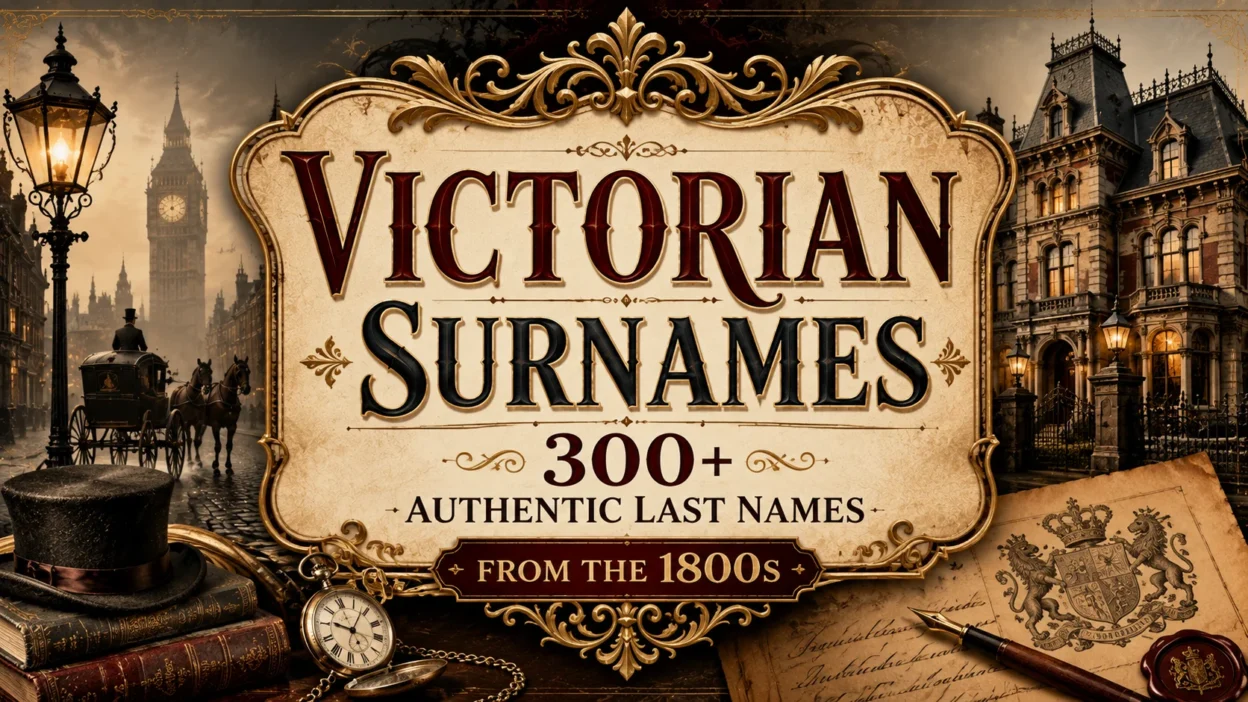
Victorian surnames offer a fascinating window into the social structure, occupations, and family histories of 19th-century Britain. During Queen Victoria’s reign from 1837 to 1901, surnames were more than just identifiers—they were markers of class, profession, and geographic origin. Working-class families often carried occupational names like Smith or Taylor, while the aristocracy bore names connected to estates and royal lineages.
This collection delivers over 300 authentic Victorian surnames across multiple categories, from the most common names of the era to elegant aristocratic choices and gothic-inspired options perfect for historical fiction, genealogy research, or simply exploring family history.
What Defines a Victorian Surname?
Victorian surnames in England and Wales evolved from a medieval naming practice known as “byname,” where a person’s occupation, locality, or a distinguishing nickname would be added to differentiate individuals with the same Christian name. By the 19th century, surnames had become hereditary and were passed down through family lines. The Victorian era saw surnames used as a way to navigate the class system—working-class people were often named based on a family profession, while the aristocracy would have surnames similar to those of royal families. More than half of Victorian surnames were derived from the Christian or fore-name of the father.
Most Common Victorian Surnames
In 1853, these fifty surnames represented nearly 18% of the English and Welsh population. Smith topped the list with over 253,000 people, followed by Jones and Williams.
- Smith – Blacksmith, most common surname
- Jones – Son of John
- Williams – Son of William
- Taylor – Tailor, clothing maker
- Davies – Son of David
- Brown – From complexion or clothing
- Thomas – From the first name Thomas
- Evans – Son of Evan
- Roberts – Son of Robert
- Johnson – Son of John
- Robinson – Son of Robin
- Wilson – Son of Will
- Wright – Skilled woodworker
- Wood – One who lived or worked in the forest
- Hall – One who lived or worked in a noble’s hall
- Walker – One who pounds wool with feet
- Hughes – From the first name Hugh
- Green – One who lived near the village green
- Lewis – From the first name Lewis
- Edwards – Son of Edward
- Thompson – Son of Thomas
- White – From complexion or clothing
- Jackson – Son of Jack
- Turner – One who makes small objects from wood
- Hill – One who lived on or near a hill
- Harris – Son of Harry
- Clark – Clerk or member of the clergy
- Cooper – Maker of wooden barrels
- Watson – Son of Watt
- Shaw – One who lived near a thicket
- Lee – One who lived near a meadow or clearing
- Bennett – From the first name Bennet
- Carter – One who transports goods by cart
- Griffiths – Son of Gruffudd
Occupational Victorian Surnames
Most working-class families had surnames that originated from their family’s profession or trade . These names provide insight into the trades and crafts of the era.
- Smith – Blacksmith
- Taylor – Tailor
- Wright – Skilled woodworker
- Cooper – Maker of wooden barrels
- Baker – Baker of bread
- Cook – Cook, food preparer
- Carpenter – Woodworker
- Turner – One who makes small objects from wood
- Fletcher – Arrow maker
- Thatcher – One who thatches roofs
- Weaver – Weaver of cloth
- Walker – One who pounds wool with feet
- Dyer – Cloth dyer
- Fisher – Catcher of fish
- Mason – One who does masonry work
- Parker – Gamekeeper at a park
- Carter – One who transports goods by cart
- Clark – Clerk or member of the clergy
- Chapman – Seller of goods at the market
- Foster – Forrester
- Inman – Innkeeper
- Brewster – Female brewer
- Wheeler – Wheelwright
- Knight – Soldier
- Baxter – Baker
- Culpepper – Herbalist or spicer
- Miller – One who grinds grain
- Butcher – One who prepares meat
- Sawyer – One who saws wood
- Tanner – One who tans leather
- Glover – One who makes gloves
- Roper – One who makes rope
- Fuller – One who fulls cloth
- Steward – One who manages household affairs
- Chandler – Candle maker
- Spicer – One who sells spices
- Webb – Weaver
- Butler – Household official
Patronymic Victorian Surnames
More than half of Victorian surnames were derived from the Christian or fore-name of the father . These “son of” names were among the most common in the era.
- Jones – Son of John
- Williams – Son of William
- Davies – Son of David
- Thomas – From the first name Thomas
- Evans – Son of Evan
- Roberts – Son of Robert
- Johnson – Son of John
- Robinson – Son of Robin
- Wilson – Son of Will
- Edwards – Son of Edward
- Thompson – Son of Thomas
- Jackson – Son of Jack
- Harrison – Son of Harry
- Davis – Son of David
- Morris – Son of Maurice
- James – From the first name James
- Morgan – Son of Morgan
- Allen – From the first name Alan
- Phillips – Son of Phillip
- Watson – Son of Watt
- Bennett – From the first name Bennet
- Griffiths – Son of Gruffudd
- Collins – Son of Collin
- Davidson – Son of David
- Hughes – From the first name Hugh
- Lewis – From the first name Lewis
- Pritchard – Son of Richard
- Price – Son of Rhys
- Walters – Son of Walter
- Matthews – Son of Matthew
- Simmons – Son of Simon
- Stevens – Son of Stephen
- Richards – Son of Richard
- Howell – Son of Hywel
- Powell – Son of Howell
- Bevan – Son of Evan
- Bowen – Son of Owen
- Meredith – Son of Maredudd
- Llewellyn – From the first name Llywelyn
- Gwilym – Welsh variation of William
- Jenkin – Flemish for “little John”
- Ivan – Russian form of John
- Mahala – Hebrew and Arabic, meaning “tender”
- Tryphena – Greek, meaning “softness, delicacy”
- Alfreda – English, meaning “elf power”
- Granville – English place name and surname
- Hedley – English surname, “heather clearing”
- Jarvis – English variation of Gervase
- Livingstone – English surname, “Leofwine’s settlement”
- Ely – Russian variation of Eli
Biblical Victorian Surnames
Biblical names were quite popular in the Victorian era and names were borrowed from the New Testament and the Old Testament . Some aristocrats sought inspiration from the Bible to create new names for their families.
- Abraham – Father of many nations
- Abrams – Son of Abraham
- Adam – From the biblical first man
- Benjamin – Son of the right hand
- Caine – After the biblical figure Cain
- Daniel – God is my judge
- David – Beloved
- Eli – Ascended, uplifted, high
- Elias – My God is Yahweh
- Elizabeth – God is my oath
- Emanuel – God is with us
- Gabriel – God is my strength
- Isaac – He will laugh
- Israel – He who struggles with God
- Jacob – Supplanter
- Jeremiah – God will uplift
- Jesse – Gift
- Joel – Yahweh is God
- Jonah – Dove
- Jonathan – Gift of God
- Joseph – He will add
- Joshua – God is salvation
- Judah – Praised
- Levi – Joined
- Luke – Light-giving
- Mark – Warlike
- Matthew – Gift of God
- Moses – Drawn out of the water
- Nathaniel – Given by God
- Noah – Rest, comfort
- Paul – Small, humble
- Peter – Rock
- Philip – Lover of horses
- Rachel – Ewe
- Rebecca – To bind
- Rebekah – To bind
- Ruth – Friend, companion
- Samuel – Heard by God
- Sarah – Princess
- Seth – Appointed
- Silas – Of the forest
- Simon – He has heard
- Solomon – Peace
- Stephen – Crown
- Susannah – Lily
- Tobias – God is good
- Zachariah – God has remembered
- Zebedee – Gift of God
Regional Flavors: English Surnames
The most common English names across the Victorian period included many occupational or descriptive names. Names with a Welsh origin also featured prominently .
- Smith – Most common English surname
- Jones – Welsh origin, son of John
- Williams – Welsh origin, son of William
- Taylor – Occupational
- Brown – Descriptive
- Wilson – Son of Will
- Davies – Welsh origin
- Evans – Welsh origin
- Thomas – From the first name
- Johnson – Son of John
- White – Descriptive
- Harris – Son of Harry
- Lewis – Welsh origin
- Clarke – Cleric or scribe
- Wright – Woodworker
- Walker – Wool worker
- Green – Descriptive
- Hall – One who lived or worked in a noble’s hall
- Wood – One who lived or worked in the forest
- Hill – One who lived on or near a hill
- Cooper – Barrel maker
- Turner – Woodworker
- Carter – Transport by cart
- Baker – Baker
- Ward – One who guards or protects
- Harrison – Son of Harry
- Davis – Son of David
- Martin – From the first name Martin
- James – From the first name James
- Morgan – Welsh origin
- Allen – From the first name Alan
- Cook – Cook
- Moore – One who lived on a moor
- Parker – Gamekeeper
- Price – Son of Rhys
- Phillips – Son of Phillip
- Watson – Son of Watt
- Shaw – One who lived near a thicket
- Lee – One who lived near a meadow
- Bennett – From the first name Bennet
- Griffiths – Son of Gruffudd
- Richards – Son of Richard
- Stevens – Crown
- Thompson – Son of Thomas
- Jackson – Son of Jack
- Hughes – From the first name Hugh
- Morris – Son of Maurice
- Baxter – Baker
- Brewster – Female brewer
Regional Flavors: Welsh Surnames
Wales’ shift from true patronymics to fixed surnames accelerated in the 18th and 19th centuries. That’s why Victorian Wales is rich in a handful of surnames like Jones, Williams, Evans, Thomas, and Davies .
- Jones – Most common Welsh surname
- Williams – Son of William
- Evans – Son of Evan
- Thomas – From the first name
- Davies – Son of David
- Hughes – From the first name Hugh
- Edwards – Son of Edward
- Morgan – Welsh origin
- Lewis – From the first name Lewis
- Price – Son of Rhys
- Pritchard – Son of Richard
- Powell – Son of Howell
- Bevan – Son of Evan
- Bowen – Son of Owen
- Meredith – Son of Maredudd
- Howell – Son of Hywel
- Llewellyn – From the first name Llywelyn
- Gwilym – Welsh variation of William
- Griffiths – Son of Gruffudd
- Walters – Son of Walter
- Matthews – Son of Matthew
- Phillips – Son of Phillip
- Parry – Son of Harry
- Lloyd – Grey
- Vaughan – Small
- Owen – Noble
- Rees – Enthusiasm
- Rhys – Enthusiasm
- Tudor – Welsh royal dynasty
- Glyndwr – Welsh prince
- Hopkin – Little Hopkin
- Bleddyn – Wolf
- Cynan – Leader
Regional Flavors: Scottish Surnames
Scottish surnames leaned heavily on Mac/Mc patronymics and clan associations. Campbell, Stewart, Gordon, Fraser, and Murray were all clan-linked names .
- MacDonald – Son of Donald
- Campbell – Crooked mouth
- Stewart – Steward
- Gordon – Large fortification
- Fraser – Strawberry
- Murray – Settlement by the sea
- McKenzie – Son of Kenneth
- MacGregor – Son of Gregory
- MacLeod – Son of Leod
- MacDonald – Clan Donald
- MacKenzie – Son of Kenneth
- MacIntosh – Son of the chieftain
- MacLean – Son of the servant of John
- MacNeil – Son of Neil
- MacPherson – Son of the parson
- Buchanan – House of the canon
- Cameron – Crooked nose
- Douglas – Black water
- Drummond – Ridge
- Duncan – Brown warrior
- Forbes – Field
- Graham – Gravelly homestead
- Grant – Great
- Hamilton – Crooked hill
- Hunter – Hunter
- Johnston – John’s town
- Keith – Forest
- Kennedy – Helmeted head
- Lindsay – Lincoln’s island
- MacDonald – Son of Donald
- MacKenzie – Son of Kenneth
- MacLean – Son of the servant of John
- MacLeod – Son of Leod
- MacMillan – Son of the bald one
- MacPherson – Son of the parson
- Morrison – Son of Morris
- Munro – From the river Roe
- Murray – Settlement by the sea
- Ogilvie – From the high place
- Robertson – Son of Robert
- Ross – Headland
- Scott – From Scotland
- Sinclair – Saint Clair
- Stewart – Steward
- Sutherland – Southern land
- Wallace – Welshman
Regional Flavors: Irish Surnames
Victorian Ireland featured O’ and Mac/Mc names that were also common in Irish communities across England, Scotland, and Wales .
- O’Brien – Descendant of Brian
- O’Neill – Descendant of Niall
- O’Connor – Descendant of Conchobhar
- O’Sullivan – Descendant of Súileabhán
- O’Reilly – Descendant of Raghallach
- O’Malley – Descendant of Máel Sechlainn
- MacCarthy – Son of Cárthach
- McDonagh – Son of Donogh
- O’Rourke – Descendant of Ruarc
- O’Carroll – Descendant of Cearbhall
- O’Kennedy – Descendant of Cinnéide
- O’Mahony – Descendant of Mathghamhain
- O’Donoghue – Descendant of Donnchadh
- MacNamara – Son of the sea warrior
- O’Dwyer – Descendant of Dubhghall
- O’Dea – Descendant of Deaghadh
- O’Flaherty – Descendant of Flaithbheartach
- O’Grady – Descendant of Grádha
- O’Higgins – Descendant of Uigín
- O’Leary – Descendant of Laoghaire
- O’Loughlin – Descendant of Lochlann
- O’Neil – Descendant of Niall
- O’Shaughnessy – Descendant of Seachnasach
- O’Shea – Descendant of Séaghdha
- O’Toole – Descendant of Tuathal
- Kelly – Descendant of Ceallach
- Murphy – Sea warrior
- Byrne – Descendant of Bran
- Ryan – Little king
- Walsh – Welshman
- Doyle – Descendant of Dubhghall
- Fitzgerald – Son of Gerald
- Fitzpatrick – Son of Patrick
- Fitzroy – Son of the king
Elegant and Aristocratic Victorian Surnames
The Victorian aristocracy bore surnames connected to estates, royal connections, and old money . These names carried an air of noble heritage and old-world sophistication.
- Abernathy – Location name
- Archibald – From the first name
- Bartholomew – Son of Tolmai
- Bellamy – Beautiful friend
- Buckingham – Place name, associated with royalty
- Carnegie – Old money name
- Cromwell – Historical political family
- Everly – Wild boar or clearing in the woods
- Fairchild – Beautiful child
- Granville – Large town, aristocratic heritage
- Grosvenor – Great hunter
- Hamilton – Crooked hill
- Harwood – Location name
- Livingstone – Leofwine’s settlement
- Nathaniel – Given by God
- Pembroke – Location name
- Windsor – Royal family name
- Winthrop – Wine village
- Seymour – Saint Maur
- Molyneux – Lancastrian French origin
- Wilberforce – Yorkshire origin
- Rochester – Red fortress
- Darcy – From Arcy
- Montague – From Montacute
- Percy – From Percy
- Spencer – Steward
- Talbot – Messenger
- Howard – Steward
- Stanley – Stone clearing
- Warren – Animal enclosure
- Clifford – Ford near a cliff
- Cavendish – From Cavendish
- Churchill – Church hill
- Devonshire – From Devonshire
- Lancaster – From Lancaster
- Rutland – From Rutland
- Pelham – From Pelham
- Russell – Red-haired
- Sinclair – Saint Clair
- Hamilton – From Hamilton
- Campbell – Crooked mouth
- Stewart – Steward
- Fitzgerald – Son of Gerald
- Fitzpatrick – Son of Patrick
- Fitzroy – Son of the king
- Beckham – Located near a small stream
- Berkeley – Location name
- Caulfield – Cold field
- Chadwick – From the town of warriors
- Cleveland – Cliff land
- Dalton – Valley town
- Eaton – One who lives near an island or river
- Enfield – One who lives near a lamb field
- Godfrey – From the first name
- Hepburn – High burial mound
- Lyon – Lion
- Masterson – Master
- Milton – Mill town
- Neville – New town
- Osbourne – Divine bear
- Reeves – Sheriff
- Truman – Trusty man
- Warner – Coveted warrior
- Ashford – Location name
- Archer – One who practices archery
- Arkwright – Someone who makes chests
- Barron – Noble fighter or warrior
- Blythe – Happy and joyous
- Tripp – To dance
Gothic and Dark Victorian Surnames
These names evoke the mysterious, brooding atmosphere of Gothic literature set in the Victorian era .
- Ashcroft – Ash tree enclosure
- Blackthorne – Thorny black bush
- Blackwood – Dark forest
- Crowley – Crow clearing
- Dashwood – Location name
- Eldritch – Otherworldly
- Graves – Steward
- Hawthorne – Hawthorn bush
- Lockhart – Enclosed place
- Marlowe – Remnants of a lake
- Rochester – Red fortress
- Sinclair – Saint Clair
- Somerset – Summer settlement
- Spencer – Steward
- Stokes – Place name
- Sutton – South town
- Thornton – Thorn tree farm
- Wainwright – Wagon maker
- Wexford – From the west
- Whitmore – White moor
- Wickham – Village with a bay
- Winslow – Hill of victory
- Winter – Season name
- Withers – From the tree
- Woolf – Wolf
- Wren – Bird name
- Wyatt – Son of Guy
- Wyckoff – Village
- Wycliffe – White cliff
- Wyman – Warrior
- Wyndham – From the village
- Wynn – Fair or blessed
- Yardley – Enclosure
- Yates – Gates
- Yeats – Many gates
- York – From York
- Young – Young
- Yule – Christmas time
- Zouch – From the marsh
- Ashbourne – Location name
- Barrett – Trouble
- Caine – After the biblical figure
- Corbyn – Raven
- Corvus – Latin for raven
- D’Arcy – From Arcy
- Drake – Dragon
- Grimm – Stern or severe
- Hale – Hollow
- Hargrave – Grey grove
- Hyde – After Dr. Jekyll and Mr. Hyde
- Knox – Location name
- Le Fay – The fairy
- Lestrange – Strange
- Lockwood – Enclosed wood
- Lovelace – Loveless
- Mortenson – Son of death
- Mortimer – Dead water or still water
- Radcliff – Red cliff
- Ravenhill – From the Old Norse first name
- Ravenswood – Forest with ravens
- Sebastian – From the first name
- Stern – Stern or severe
- Thorne – One who lives near a thorn bush
- Thornfield – Field of thorns
- Underwood – Dweller at the edge of the woods
- Usher – In reference to The Fall of the House of Usher
- Abraham – Father of many nations
- Abrams – Son of Abraham
Locational Victorian Surnames
Many Victorian surnames originated from the places where families lived or worked. These names offer clues to geographic origins.
- Wood – One who lived or worked in the forest
- Hall – One who lived or worked in a noble’s hall
- Hill – One who lived on or near a hill
- Moore – One who lived on a moor
- Green – One who lived near the village green
- Shaw – One who lived near a thicket
- Lee – One who lived near a meadow or clearing
- Clark – From the occupation of clerk
- Parker – Gamekeeper at a park
- Ward – One who guards or protects
- Brooke – One who lived near a brook
- Field – One who lived in the fields
- Ford – One who lived near a ford
- Clifford – Ford near a cliff
- Clifton – Cliff settlement
- Clinton – Settlement by a hill
- Coleman – Coal burner
- Collins – Son of Collin
- Colton – Coal town
- Conway – Holy water
- Cook – Cook
- Cooper – Barrel maker
- Corbett – Little crow
- Cox – Son of Cock
- Craig – From the crag
- Crawford – Crow ford
- Curtis – Courteous or curate
- Dallas – From the meadow
- Dalton – Valley town
- Daniels – Son of Daniel
- Darcy – From Arcy
- Darling – Dear one
- Davies – Son of David
- Davis – Son of David
- Dawson – Son of Daw
- Day – One who served the church
- Dean – Valley
- Dennis – From Dennis
- Denton – Valley settlement
- Devon – From Devon
- Dixon – Son of Dick
- Dodd – One who lives near a dodd
- Dyson – Son of Dye
- Earl – Nobleman
- Eaton – River settlement
- Edgar – Rich spear
- Edwards – Son of Edward
- Eliott – Descendant of Eliott
- Ellis – Son of Elias
- Emerson – Son of Emery
- Evans – Son of Evan
- Everett – Son of Everard
- Eyre – One who lives near a lake
Victorian Surnames from Literature and History
These names appear in Victorian literature, historical records, and famous families of the era.
- Liddell – The family of Alice Liddell, inspiration for Alice’s Adventures in Wonderland
- Carroll – Lewis Carroll, author of Alice’s Adventures in Wonderland
- Dodgson – Carroll’s real surname
- Hargreaves – The last name of the man Alice Liddell married
- Reeves – Alice’s mother’s maiden name
- Nightingale – Florence Nightingale, pioneering nurse
- Dickens – Charles Dickens, famous Victorian author
- Brontë – The Brontë sisters, Victorian literary family
- Darwin – Charles Darwin, naturalist
- Tennyson – Alfred Lord Tennyson, Poet Laureate
- Browning – Elizabeth Barrett Browning and Robert Browning, poets
- Carlyle – Thomas Carlyle, historian and philosopher
- Ruskin – John Ruskin, art critic and social thinker
- Mill – John Stuart Mill, philosopher and economist
- Thackeray – William Makepeace Thackeray, novelist
- Gaskell – Elizabeth Gaskell, novelist
- Eliot – George Eliot (Mary Ann Evans), novelist
- Trollope – Anthony Trollope, novelist
- Hardy – Thomas Hardy, novelist and poet
- Stevenson – Robert Louis Stevenson, novelist
- Kipling – Rudyard Kipling, writer
- Hopkins – Gerard Manley Hopkins, poet
- Arnold – Matthew Arnold, poet and critic
- Newman – John Henry Newman, theologian
- Pugin – Augustus Welby Pugin, architect
- Morris – William Morris, designer and writer
- Burne-Jones – Edward Burne-Jones, artist
- Rossetti – Dante Gabriel Rossetti, artist and poet
- Millais – John Everett Millais, painter
- Hunt – William Holman Hunt, painter
- Waterhouse – John William Waterhouse, painter
- Leighton – Frederic Leighton, painter
- Alma-Tadema – Lawrence Alma-Tadema, painter
- Sargent – John Singer Sargent, painter
- Whistler – James McNeill Whistler, painter
- Gladstone – Victorian Prime Minister
- Disraeli – Victorian Prime Minister
Nickname and Descriptive Victorian Surnames
Some Victorian surnames started as personal descriptors—physical characteristics, personality traits, or even animals.
- Short – Below average height
- Long – Tall
- Little – Small
- Strong – Physically powerful
- Swift – Fast-moving
- Young – Younger
- Goodman – Good man
- Goodwin – Good friend
- Sharp – Sharp-minded or sharp-featured
- Armstrong – Strong arm
- Brown – Brown complexion or clothing
- Black – Dark complexion
- White – Pale complexion
- Gray – Grey hair or clothing
- Green – Lived near the green or wore green
- Fox – Cunning like a fox
- Lamb – Gentle like a lamb
- Hogg – Young sheep
- Bull – Strong like a bull
- Bird – Small or bird-like
- Peacock – Vain like a peacock
- Wolf – Wolf-like
- Stout – Stocky or strong
- Small – Short
- Meek – Gentle
- Stern – Severe or strict
- Grimm – Stern or severe
- Blake – Dark or fair
- Blythe – Happy and joyous
- Tripp – To dance
- Darling – Dear one
- Curtis – Courteous
- King – One who served the king or acted like royalty
- Knight – Soldier
- Lord – One who played the Lord in mystery plays
- Virgin – One who played the Virgin in mystery plays
- Death – One who played Death in mystery plays
- Reed – Red-haired
Double-Barrelled Victorian Surnames
Double-barrelled and hyphenated surnames were fashionable among the aristocracy and landed gentry, often to preserve a mother’s family name or fulfill inheritance conditions .
- Cavendish-Bentinck – Aristocratic double name
- Pelham-Clinton – Noble double name
- Stuart-Wortley – Aristocratic double name
- Montagu-Douglas-Scott – Noble double name
- Stanley-Montague – Aristocratic double name
- Lyon-Dalberg-Acton – Noble double name
- Smith-Dorrien – Gentry double name
- Herbert-Hughes – Aristocratic double name
- Lloyd-George – Political double name
- Baring-Gould – Gentry double name
- Ponsonby-Fane – Aristocratic double name
- Sackville-West – Noble literary double name
- Cavendish-Scott-Bentinck – Triple barrelled
- Grosvenor-Chester – Aristocratic double name
- Plunkett-Ernle-Erle-Drax – Multiple barrelled
- Tempest-Hicks – Gentry double name
- Montgomery-Cuninghame – Noble double name
- Drummond-Wolff – Aristocratic double name
- Campbell-Bannerman – Political double name
- Cholmondeley-Featherstonehaugh – Complex aristocratic
How Victorian Surnames Were Created
Victorian surnames typically originated from one of several sources. Occupational names came from the family trade—Smith (blacksmith), Taylor (tailor), Wright (woodworker), and Cooper (barrel maker) . Patronymic names derived from the father’s Christian name—Jones (son of John), Williams (son of William), and Johnson (son of John). Locational names came from the places where families lived—Wood, Hall, Hill, Green, and Shaw. Nickname surnames described physical features or personality traits—Brown, White, and Good. Finally, some surnames came from offices or positions of authority—King, Bishop, and Knight.
Using Victorian Surnames for Characters
When choosing a Victorian surname for a fictional character, consider the character’s social class and background. A working-class character might have an occupational name like Smith or Taylor. An aristocratic character could bear an elegant name like Granville or Pembroke . A mysterious Gothic character might suit Ashcroft or Blackthorne. The surname should reflect the character’s identity and the world they inhabit.
Understanding Surname Changes in the Victorian Era
Names could change for various reasons during the Victorian period. If a family disappears from the census, they might be living under false names to escape debts—a not uncommon occurrence in Victorian and Edwardian times . Some names were changed upon migration, with new surnames formed based on new languages and places. Slight misspellings were also frequent; Phillip and Philips were often confused, as were Mathews and Matthews, Murry and Murray, Marsland and Marland, and Reay and Rea.
The Meaning Behind Surname Origins
Every surname contains a buried history. Names carry hidden social histories that reveal ancestral trades, physical appearance, geographic origins, and sometimes something more rare. Understanding the origin of a Victorian surname provides insight into the family’s past—whether they were metalworkers (Smith), tailors (Taylor), or came from a specific place like Hill or Wood. Some names even suggest ancestral trades like Butcher, Roper, or Thynne .
Surnames as Windows to the Past
Surnames are much more than convenient identity tags; they are windows into families’ pasts . Some suggest ancestral trades or physical appearance. Some provide clues to where families came from. And some offer a hint of something just a little more esoteric. The Victorian era’s obsession with status signals made surnames one of the markers of class distinction. A Smith could be a dock laborer or a member of the gentry, showing that surnames provided hints rather than guarantees about a person’s social standing.
Frequently Asked Questions (FAQ)
What were common Victorian surnames?
The most common Victorian surnames in 1853 were Smith, Jones, Williams, Taylor, Davies, Brown, Thomas, Evans, Roberts, and Johnson. Smith was the most common with over 253,000 people, and more than half of all surnames were derived from the father’s Christian name.
What are elegant Victorian surnames?
Elegant Victorian surnames include Abernathy, Archibald, Bartholomew, Bellamy, Everly, Fairchild, Granville, Harwood, Nathaniel, and Pembroke. These names were often associated with the aristocracy and upper classes.
What are Gothic Victorian surnames?
Gothic Victorian surnames include Ashcroft, Blackthorne, Crowley, Dashwood, Eldritch, Graves, Hawthorn, Marlowe, Rochester, and Sinclair. These names evoke the mysterious, brooding atmosphere of Victorian Gothic literature.
How did Victorians get their surnames?
Victorian surnames typically originated from the family trade (occupational names), from the father’s Christian name (patronymic names), from the place where the family lived (locational names), from physical or personality traits (nickname surnames), or from offices or positions of authority.
What are occupational Victorian surnames?
Occupational Victorian surnames include Smith (blacksmith), Taylor (tailor), Wright (woodworker), Cooper (barrel maker), Baker (baker), Fisher (fisherman), Carpenter (woodworker), Turner (wood turner), and Fletcher (arrow maker).
What were the top 10 Victorian surnames?
The top 10 most popular Victorian surnames in 1853 were Smith, Jones, Williams, Taylor, Davies, Brown, Thomas, Evans, Roberts, and Johnson. Smith was the most popular with 253,600 people, followed by Jones with 242,100.
What are some rare Victorian surnames?
Some rarer Victorian surnames from the period include Chaceporc, Swetinbeddes, Tichborne, Molyneux, Wilberforce, Fawkes, Atkin, Tautz, Giblin, Guyan, Clague, Shimmin, Teare, and Pritchard.
What Welsh surnames were common in the Victorian era?
Welsh surnames common in the Victorian era included Jones, Williams, Evans, Thomas, Davies, Hughes, Edwards, Morgan, Lewis, Price, Pritchard, Powell, Bevan, Bowen, and Meredith.
What Scottish surnames were common in the Victorian era?
Scottish surnames common in the Victorian era included MacDonald, Campbell, Stewart, Gordon, Fraser, Murray, McKenzie, MacGregor, MacLeod, MacLean, MacPherson, and Morrison.
What Irish surnames were common in the Victorian era?
Irish surnames common in the Victorian era included O’Brien, O’Neill, O’Connor, O’Sullivan, O’Reilly, MacCarthy, McDonagh, Kelly, Murphy, Byrne, Ryan, Walsh, and Doyle.
Conclusion
Victorian surnames offer a fascinating glimpse into the social fabric of 19th-century Britain. From the common occupational names like Smith and Taylor to the elegant aristocratic names like Granville and Pembroke, these surnames carry the history of class, profession, and family lineage. More than half of Victorian surnames derived from the father’s Christian name, while others came from occupations, locations, or nicknames. Whether for genealogy research, historical fiction writing, or simply exploring family history, understanding Victorian surnames provides a richer appreciation of how identity was shaped in the age of Queen Victoria.

Muhammad Sohail Asghar is the author of NamezioHub. He is passionate about exploring and sharing unique, aesthetic, and creative name ideas. Through NamezioHub, he helps readers discover stylish usernames, cool nicknames, business name ideas, and creative names for different purposes. His goal is to provide a helpful platform where people can easily find modern and inspiring names that stand out.